Developer sales, recognised revenue and backlog answer different business questions. Their definitions and reporting scope explain what each figure means; property specific evidence is still needed to assess a selected home.
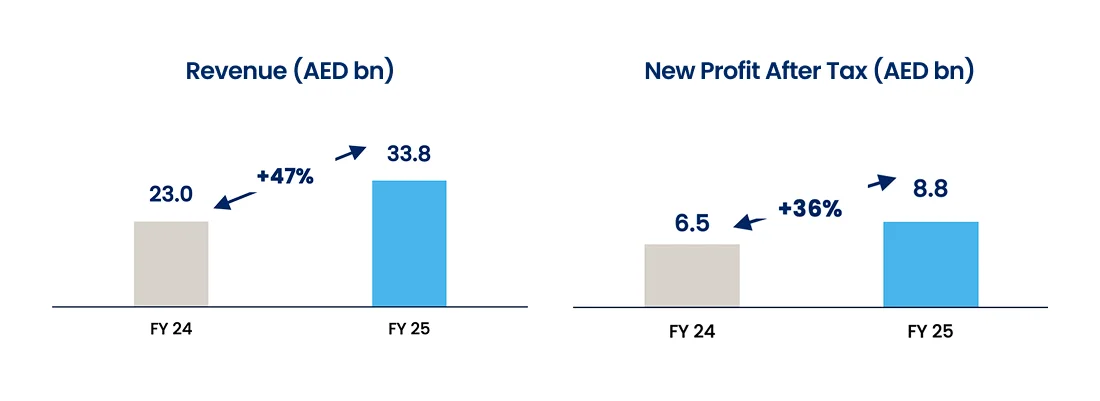
Aldar’s published FY2025 results graphic compares group revenue and new profit after tax. Neither series is developer sales or development backlog. Retain the company’s reporting definitions and period when reading it. Image source: Aldar.
Aldar's 2025 results announcement reports group sales and a development backlog alongside financial performance. It is a useful example of why the labels and reporting scope must remain attached to each number.
A reconciliation explains movement without certifying a home
A simple backlog exercise shows why the three measures should not be added or subtracted casually.
Imagine opening backlog of 180, new contracted business of 100, revenue recognised from backlog of 60 and cancellations of 10. With no other adjustments, the illustrative closing balance is 210: 180 plus 100 minus 60 minus 10. All figures are invented units for teaching; they are not Aldar data or a statement of its precise accounting definition.
| Illustrative movement | Units |
|---|---|
| Opening balance | 180 |
| Additions | 100 |
| Recognition from that balance | 60 |
| Cancellations | 10 |
| Closing balance under these assumptions | 210 |
The assumptions matter. The calculation only works if every movement uses the same scope and definition, and no relevant adjustment is omitted. A real report may define backlog and recognition differently, so its notes govern the reconciliation.
Even a correct reconciliation cannot identify the condition or delivery status of a particular apartment. It describes movement in a company measure. To assess a home, you still need its own project and unit evidence.
The useful reading habit is to ask which business question each figure answers before applying it to a housing decision.
Sales describe transactions under the report's definition
Read the company's definition, reporting period and geographic scope. A group sales figure may include more than the Abu Dhabi residential project you are researching.
Do not assume it means cash fully received or homes already handed over. Look for the report's explanation of what is counted and whether cancellations or other adjustments are discussed.
For a property shortlist, the figure provides company context. It does not establish the current asking price or availability of your selected unit.
Revenue belongs to the financial reporting period
Recognised revenue is reported under the company's accounting policies. For development activity, the timing may differ from signing a sale or completing a home.
Read the relevant policy and segment notes before comparing revenue with a launch sales announcement. A difference between the two is not, by itself, proof of a discrepancy or a completed delivery.
Backlog points to work or revenue still ahead
Use the exact backlog definition in the report. Check whether it refers to development sales, contracted revenue or a wider set of projects and services.
A large figure can indicate committed business under that definition, but it does not tell you which specific unit is ready or whether its programme has changed.
A simple reading worksheet
Imagine a company reports 100 in new sales, 60 in recognised revenue and 180 in closing backlog. The figures are illustrative units, not Aldar's results. It would be wrong to conclude that the difference between new sales and revenue identifies 40 of completed, unpaid homes. Revenue may relate to earlier sales, backlog may contain several periods of contracted work, and the report's definitions determine what is comparable.
To explain the figures, you would need the opening backlog, additions, recognition, cancellations and other adjustments within the same scope. Even then, the company level reconciliation would not identify your selected apartment's physical readiness. That requires property specific evidence.
For each number, record five items: measure, period, business scope, definition and the question it can answer.
Then add a separate line for the home you are considering. Its evidence may include the project reference, current programme and unit documents. Keep that line outside the company metric comparison.
This separation prevents a strong corporate announcement from doing work it cannot do. It also prevents an unexplained difference between sales and revenue from being treated as a warning without understanding the accounting context.
Keep sales, recognised revenue and backlog attached to their definitions and reporting scope. A company reconciliation provides business context; it does not certify a selected home’s readiness or future value.